
How doublers work by mobile money
A 'double your money' offer collected through mobile money follows a pattern: a short promise, a payment to a number or till, a partial payout to early members, and a request for a further payment to 'release' money. This page explains the mechanism in words, without figures or names.
The short promise
The offer is short: send money to a number or till, and receive double back. The promise is made in a group chat or a direct message. It does not explain how the money will be doubled. It relies on the reader sending money quickly.
The promise is not a contract. It is a statement in a chat. The reader has no way to enforce it. The payment is to a mobile-money number, not to a licensed investment business.
The payment to a number or till
The reader is asked to send money to a phone number or a till number. The number is displayed in the chat. The reader sends the money through M-Pesa or another mobile-money provider. The payment is confirmed with a name registered to that number.
The name on the confirmation is the name registered to the number at the mobile-money provider. It does not show who operates the offer. The number may belong to a person, not a business.
The partial payout to early members
After the reader sends money, the offer may pay back a partial amount to early members. This payout is part of the design. It shows other members that the offer pays. It encourages them to send more money.
The payout is not profit. It is money from new members. The offer uses new money to pay old members. The reader who receives a payout may send more money, hoping for the double.
The request for a further payment
After the partial payout, the offer asks for a further payment to 'release' the doubled money. The reader is told that a fee or a tax must be paid first. The reader pays again, hoping to receive the double.
The further payment is the goal of the design. The offer collects more money from the reader. The reader may never receive the doubled amount.
Why early payouts are part of the design
Early payouts are part of the design because they create trust. A member who receives a payout tells others. The group chat shows the payout. New members send money, hoping for the same.
The payouts are not sustainable. They depend on new money. When new money stops, the payouts stop. The design relies on the reader not asking how the money is doubled.
What a reversal request can do
If the reader has sent money, a reversal request can be made to the mobile-money provider. The provider decides the request. Speed matters because the money may have moved. The provider may not reverse the payment.
The reader should contact the provider as soon as possible. The provider's decision is final. The reader should not expect a reversal to succeed.
A promise with a short window pushes a decision before a member can check a register
The message usually sets a deadline that is close to the next payday or before evening. That timing is not an accident. It gives a reader little room to ask the Capital Markets Authority whether the person behind the number has filed any caution. The pressure to act quickly makes the promise feel like an opportunity that will disappear, even though the same offer can appear in another group under a different name the following week.
A short window also cuts off the natural questions a member of a chama or social group would otherwise ask. Who keeps the records, and who can see them? Which bank account receives the pooled money, and whose name is on it? A genuine group can answer these from its own minutes. An offer that cannot wait for those answers is asking for payment before the questions are put.
The urgency also changes the role of the person who forwards the message. A relative or workmate who shares the offer may not have checked it either. They are passing on a promise, not a finding. By the time a member asks for details, the sender may only repeat the same deadline rather than explain the mechanism. The pressure has moved from the promoter to the group itself.
A till or paybill payment leaves the sender with a business name, not a person
When money moves to a till number, the confirmation shows the name that was registered with the mobile money provider. That name may be a trading name, a shelf company, or a name chosen only for the till. It does not show the person who will decide what happens to the money after it arrives. A name on a till can be bought and sold, or registered by an agent who never appears in the group chat.
A paybill works the same way but often carries more than one account under the same business number. The money goes into an account number supplied by the promoter, which may be a phone number, a membership code, or a name. That account number is the only thing that separates one member's payment from another's. If the account number is reused across different schemes, the same paybill may be collecting for more than one promise.
The sender also leaves a trail that is readable only with the mobile money provider's records. A reversal request can be made, but the provider will ask the receiving business to consent or will check whether the sender can show a clear error. A voluntary payment made after reading a promise is not treated as an error. The name on the confirmation is often the only clue, and it may lead nowhere.
An early payout creates proof that the promise paid someone, not that the system works
When a member receives a small payout soon after sending money, the screenshot of that payout becomes a recruiting tool. It is shown in the group as evidence that the doubler keeps its word. The payout is real money, and it is really received. But the payment only proves that one transfer was made to one member at one moment. It says nothing about where the money came from or whether the same will happen for the next member.
The payout is often drawn from the payments of new members who joined after the first one. The member who was paid may not know this, and may genuinely believe the scheme is generating returns. That belief makes the member a more convincing advocate. The promoter does not need to pay every member; paying a few early ones is enough to keep the group active and to attract the next round of payments.
The member who receives a payout may also be asked to send it back as a further investment, or to recruit a set number of new members before withdrawing. The first payout then becomes a hook rather than a return. If the member refuses, the promoter can point to the payout as proof that the member was treated fairly. The money that was returned did not come from a trading profit; it came from someone else's entry.
A further payment is often framed as a condition for unlocking money already shown as due
After a member has sent an initial amount, the promoter may show a balance that has grown. The member is then told that the balance cannot be withdrawn until a fee is paid, a tax is cleared, or a new tier is activated. The fee is usually smaller than the balance shown, which makes it feel like a reasonable step. But the balance shown is not money held anywhere; it is a number in a chat or on a screen.
The request for a further payment changes what the member is chasing. The original promise was that the first payment would be doubled. Now the member is paying to release a number that may not exist. Each additional payment creates a new promise, and each new promise has its own condition. The member may end up paying several fees before realising that the balance never moves.
The promoter may also ask the member to make the further payment to a different number or till than the first one. That change is not explained as a correction but as a new stage. The member's bank or mobile money statement then shows a series of small payments to different businesses, which makes it harder to describe the whole sequence as one transaction. A reversal request on the first payment does not touch the later ones.
A group chat run by strangers uses the look of a chama without its record-keeping
A genuine chama has a membership list, minutes, and a bank account controlled by elected officials. Its rules say how often members contribute, how money is loaned or invested, and how a member exits. A group chat promising doubled returns may call itself a chama, but it rarely shows minutes or a constitution. The only record is the chat itself, and the only rule is that new members must pay to join.
The strangers in the group may have no connection to each other except the phone numbers that added them. The promoter may use several numbers, or the same person may appear under different names. A member who asks for a physical meeting or a registration certificate is often told that the group operates online, or that the documents are with the lawyer. The absence of a lawyer's name or a registration number is not treated as a problem by the promoter.
The group also changes its name and its promise as it grows. What started as a crypto doubling offer may become a forex trading group, or a charity circle, without any change in the payment details. The members who joined early may not notice the change because the chat history is long and the new promise is posted daily. The only constant is the request to send money to a number.
A member who asks for a refund is often asked to wait for a batch or a cycle to close
When a member asks for money back, the promoter may say that withdrawals are processed only at the end of a cycle, or that the member's payment is still in a batch with others. The delay is presented as a technical step, not a refusal. The member may be shown a list of pending withdrawals, with the member's name on it, as proof that the refund is in progress. The list is not a bank statement.
The cycle may be described as a trading period, a wallet synchronisation, or a group rotation. Each description gives the member a reason to wait a little longer. While waiting, the member may see other members posting that they have been paid, which renews the hope. Those posts may be from the same person using different numbers, or from members who were paid from the waiting member's own money.
The promoter may also ask the member to stop posting about the refund in the group, saying that negative talk slows down the system. The member is moved to a private chat, where the promises continue without witnesses. The group then appears calm to new members who are reading it for the first time. The member who asked for a refund is no longer visible, and the new members do not know that a refund was requested.
A payment made to a doubler cannot be treated as a mistaken transfer by the mobile money provider
A reversal request works best when a sender can show that money went to a wrong number by a typo, or that a payment was made for goods that were never delivered after a clear order. A doubler payment is different. The sender chose to send money after reading a promise and agreeing to it. The mobile money provider will see a voluntary transfer to a registered till or paybill, and the confirmation will show the sender accepted the details.
The provider may still open a reversal request, but the receiving business can decline it. If the business does not respond, the provider may not force the money back without a court order or a police report. The sender is then waiting on a process that may take longer than the doubler's next withdrawal cycle. The money may have already moved from the till to a bank or to another number.
The sender's best record is the message thread that led to the payment, but that thread is not a payment instruction. It shows a promise, not an error. A provider that reviews the thread may conclude that the sender understood the risk and paid anyway. The reversal request then becomes a lesson in how mobile money treats a voluntary payment, not a way to undo one.
At a glance
Read next
Before sending to a till or paybill
What is a doubler?
A doubler is an offer to double money sent through mobile money. The offer is made in a group chat or a direct message. It asks for a payment to a number or till, and promises double back.
Why do they pay early members?
Early payouts create trust. A member who receives a payout tells others. The group chat shows the payout. New members send money, hoping for the same. The payouts depend on new money.
What happens after I send money?
After you send money, the offer may pay a partial amount. Then it asks for a further payment to 'release' the doubled money. The further payment is the goal of the design.
Can I get my money back?
You can ask the mobile-money provider for a reversal. The provider decides the request. Speed matters. The provider may not reverse the payment. The decision is final.
Is a doubler licensed?
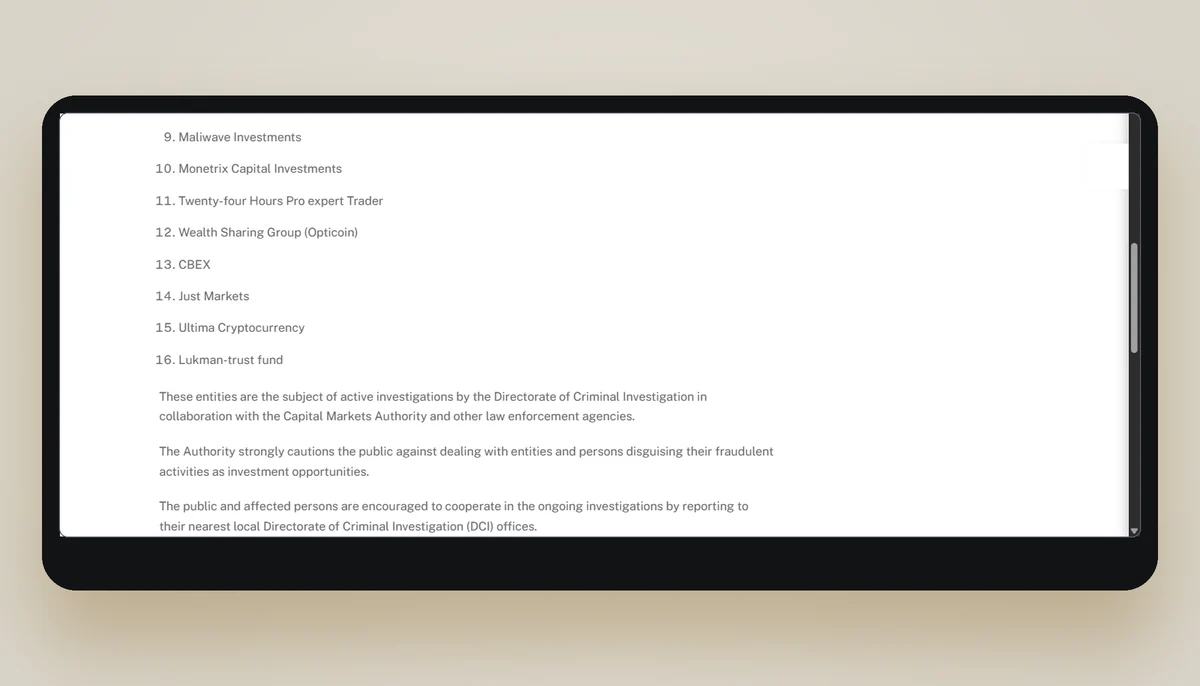
A doubler is not a licensed investment business. The payment is to a mobile-money number, not to a licensed entity. The CMA names entities it says are unlicensed in its cautions, which are press releases separate from the documents on its Public Notice page.
A trading account, not a promise
This site links to an international broker's account. Opening one means agreeing to a client agreement and a risk warning. Read both before you sign anything.