
CMA public notices by date
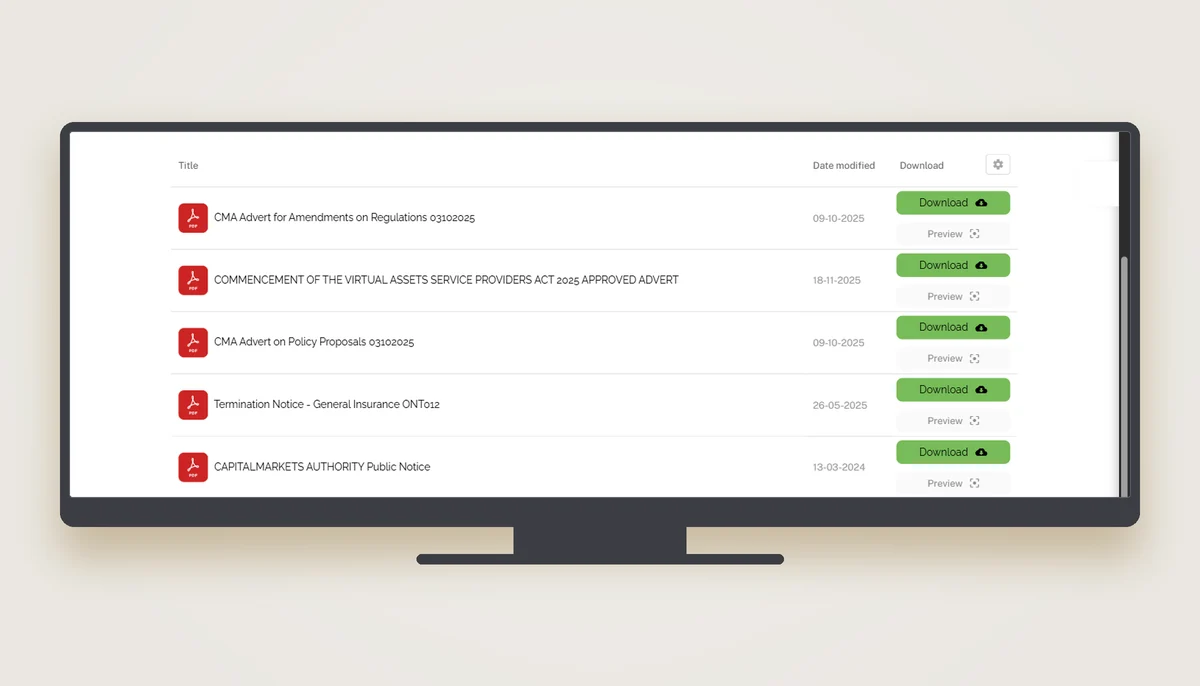
The Capital Markets Authority lists documents on its Public Notice page: advertisements about draft regulations and policy proposals, a notice on the commencement of the Virtual Asset Service Providers Act, and a termination notice. This page shows those documents in order of date. A live table sits above this text; each row records what the source published, not a finding of this site.
CMA public notices, newest first
The document title and the date modified that the CMA page gives.
| Document title as the CMA page gives it | Date modified | Kind | Source |
|---|---|---|---|
| November 2025 | |||
| COMMENCEMENT OF THE VIRTUAL ASSETS SERVICE PROVIDERS ACT 2025 APPROVED ADVERT | 18.11.2025 | Document on the Public Notice page | CMA ↗ |
| October 2025 | |||
| CMA Advert for Amendments on Regulations 03102025 | 09.10.2025 | Document on the Public Notice page | CMA ↗ |
| CMA Advert on Policy Proposals 03102025 | 09.10.2025 | Document on the Public Notice page | CMA ↗ |
| May 2025 | |||
| Termination Notice - General Insurance ONT012 | 26.05.2025 | Document on the Public Notice page | CMA ↗ |
| March 2024 | |||
| CAPITALMARKETS AUTHORITY Public Notice | 13.03.2024 | Document on the Public Notice page | CMA ↗ |
What is on the Public Notice page
The Public Notice page of the Capital Markets Authority lists documents: each has a title, a date modified and a download link. At the latest reading the page lists five: advertisements about amendments to regulations and about policy proposals, the approved advertisement on the commencement of the Virtual Asset Service Providers Act 2025, a termination notice and an earlier public notice. None of the titles names an entity as unlicensed. This site reads that page and shows the documents in order of date.
A CMA caution is a different publication: a press release that names entities the Authority says operate without the required licence. The latest one is dated 11 September 2026. The date shown in the table is the date modified that the page prints, and the site does not correct it. The table is not a live feed: it shows the reading whose date is printed under it.
The columns of the table
The table above this text has four columns. The first column gives the document title exactly as the CMA page wrote it. The second column is the date modified that the page prints. The third column is the kind of row; here every row is a document on the Public Notice page. The fourth column is a link to the document on the CMA's website.
A row records what the source published, not a finding of this site. The table does not add commentary, and it does not quote from the document. The reader can follow the link to read the full text.
Why the date matters
The date modified tells the reader when the CMA page says a document was last changed. A document dated last year is not the same as one dated yesterday. The date shows how long a document has stood on the page, not when it was first written.
The table is not updated every day. A document can appear here only when the table is read again. The reader should check the CMA's own website for the latest documents.
What to do after reading a document
If a title in the table looks relevant, the reader can open the document and read it. A title says what the document is; it does not say that any entity is unlicensed. For a platform in question, the reader can then check the entity's legal name, its home regulator, and its complaint route.
If a name does not appear in the table, that does not mean the entity is licensed. The table only shows what the CMA has published. The reader should check the CMA's own website and other regulators' registers.
Where the notices come from
The documents are read from the Public Notice page of the website of the Capital Markets Authority of Kenya. The date of the reading is printed under the table. The date shown is the one the Authority gives. A document on the Public Notice page is the regulator's own publication; it is not a court finding.
This site does not add to the notices, and it does not remove anything. The table is a copy of what the source published. The reader can verify any row by following the link.
The order in which the table is read changes the picture
A reader who starts at the top sees the most recently dated document first. That is useful for someone following a live conversation in a group chat. The date column works backwards from the present, so the first row is the document the page dates latest. A person checking a name can match it against the list from newest to oldest without scrolling.
Reading from the bottom upward gives a different view. It shows how the Authority's attention has moved over time. An older document may have been superseded by a later one on the same subject. The table does not merge rows, so the same subject can appear in more than one row with a different date.
The safest habit is to read both directions for any name that matters. A single row tells what the Authority listed on one date. A repeated subject tells that the Authority has published on it again. The reader should not assume the newest document is the only one that counts.
The table does not rank documents by importance
The list is ordered by date, not by the seriousness of the conduct. A notice published yesterday is not necessarily about a worse case than one published a month ago. The page does not attach a score or a level of importance to its documents. The order is chronological because that is how the site's feed delivers the data.
A reader who assumes the top row is the most dangerous makes a mistake. The Authority may publish a routine reminder about unlicensed activity on a day when a major scheme is also active. The table does not distinguish between a routine advertisement and a notice of greater consequence. All appear in the same list.
To judge importance, the reader must open the document itself. The table gives the title, the date, and a link. The full text of the document explains what the Authority said. The table is an index, not a rating system.
A name missing from the table is not a clean bill
The absence of a name from the table does not mean the Authority has approved the entity. The table contains only the documents the Authority lists on its Public Notice page, and none of their titles names an entity as unlicensed. Many unlicensed operators never appear because no complaint reached the Authority or because the Authority has not yet acted. The table is a list of published documents, not a register of licensed firms.
A person who checks a name and finds nothing should not conclude the offer is safe. The Authority licenses entities under the Capital Markets Act. A separate register of licensees exists on the Authority's site. The table on this page is not that register. It is a list of published documents, which is a different thing.
The correct question to ask is not whether a name is in this table. The question is whether the entity holds a licence from the Authority. If the entity is not licensed, a missing caution means only that no warning has been published yet. The reader must check the licence register separately.
At a glance
Read next
Before sending to a till or paybill
What is a CMA public notice?
A document the Capital Markets Authority of Kenya lists on its Public Notice page. At the latest reading these are advertisements about draft regulations and policy proposals, a notice on the commencement of the Virtual Asset Service Providers Act, a termination notice and an earlier public notice. A public caution against named entities is a separate kind of CMA publication, issued as a press release.
How current is the table?
The table is built from one reading of the Public Notice page, and the date of the reading is printed under the table. A document added after that reading appears when the table is read again. This site does not run on a schedule.
What does the date in the table mean?
The date is the "date modified" that the CMA page prints for the document. The site does not correct it. A document modified on a Tuesday is shown as a Tuesday. It can differ from a date written inside the document.
Does a caution mean an entity is a scam?
No. A caution says the regulator has not licensed the entity or activity. It does not say the entity is a scam or a fraud. It is a public statement, not a court finding.
If a name is not in the table, is it safe?
No. The table only shows what the CMA has published. An entity not in the table may still be unlicensed. The reader should check the CMA's own website and other regulators' registers.
A trading account, not a promise
This site links to an international broker's account. Opening one means agreeing to a client agreement and a risk warning. Read both before you sign anything.